HABILE.'s culinary philosophy in three ingredients
At HABILE., bistrot cooking means stripping back first. Three well-chosen ingredients, a balance to find, and always asking what to take away to make it better.
Culinary vocabulary has worked on its image. Ever since food became column inches and restaurants entered pop culture, everything must be named, categorised, labelled.
At HABILE., we'd rather cook.
Three ingredients, not one more
The house cooking rests on a simple principle: three ingredients that are good, clean and sustainable. Three times everything rather than three times nothing. Beetroot, raspberry, hazelnut — the unshakeable favourite. Or cauliflower, crouton, lemon — it has punch, but it holds its balance.
An image that keeps coming up in the kitchen: a chair. On two legs, you fall flat. On four, there's always one floating in the air. Here, we aim for the stool: three points of contact, a perfect seat.
This is no abstract doctrine. It's what explains why the pickled beetroots with raspberry vinegar became a dish in their own right, not a condiment. Three elements in tension — the earthiness of the vegetable, the acidity of the vinegar, the natural roundness of the raspberry — adjusted until nothing spills over. We're not trying to surprise for the sake of it. We're trying to make every bite right.
What you take away to make it better
The intention is neither Scandinavian minimalism nor Levantine baroque. It's rightness. Getting to the essential, stripping back, asking the same question over and over: what do we take away to make it better?
Making it good, not just beautiful — the Instagram trade-off. Which doesn't stop the kitchen from creating monochrome compositions, dishes on coloured plates, like so many definitions waiting to be rewritten.
It's also why a dish like stuffed cabbage — a vegetable that French cuisine long banished to the back of the pot — can become a signature. Not because it was dressed up in foam and gel. Because the time was taken to understand what it was, and everything that betrayed it was stripped away. The result: a dish that won a bronze medal in 2025. The reward was in the subtraction.
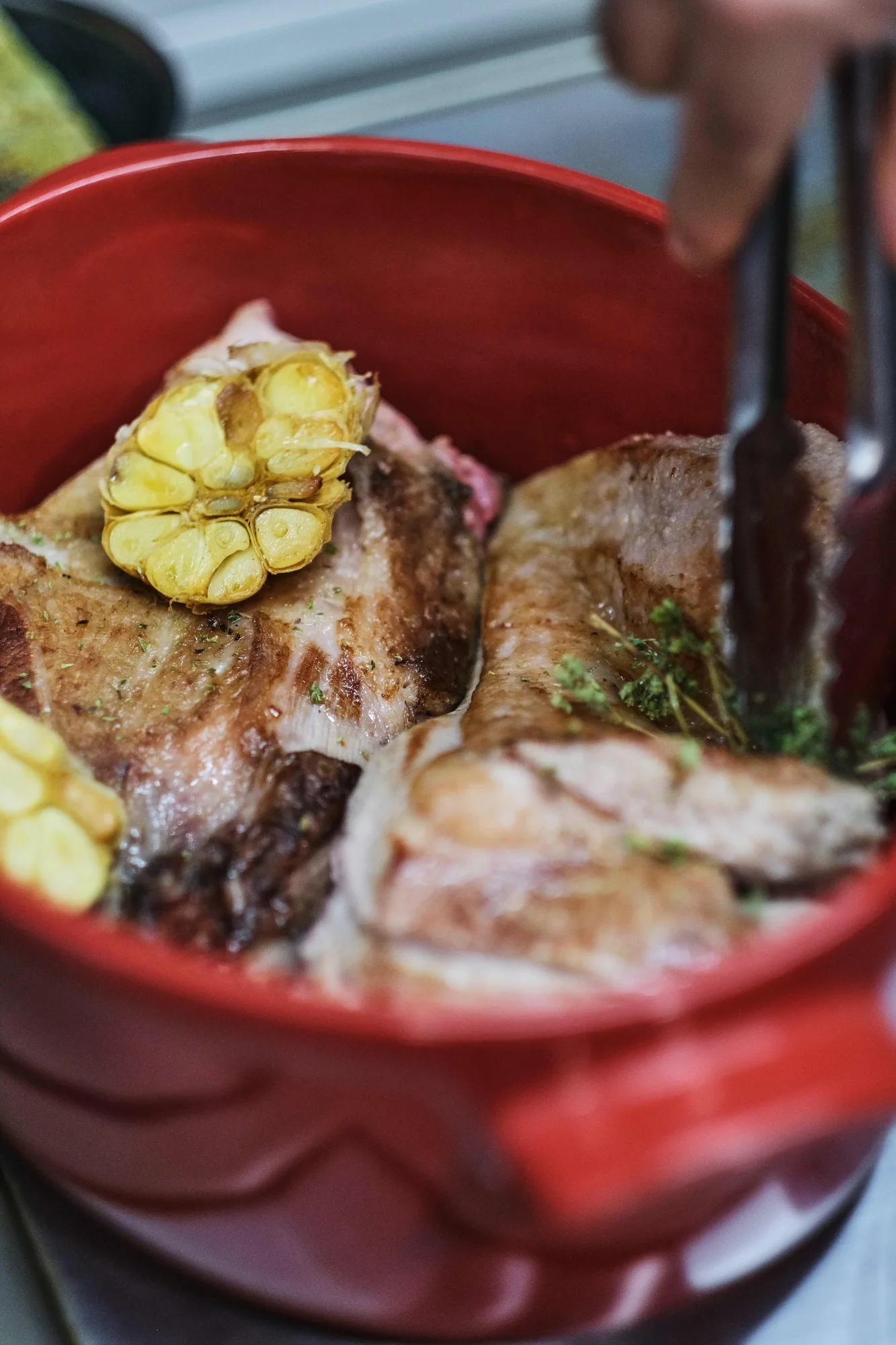
Same logic for the lamb confit eight hours. Patience isn't a marketing argument. It's an answer to a technical question: at what point does the meat say exactly what it has to say? Eight hours, not seven, not nine. We're not chasing an effect — we're looking for the right moment.
The menu as a monthly exercise in style
This three-ingredient philosophy would mean nothing if it became set in stone. At HABILE., themenuchanges every month, in step with the seasons and what the market gardeners have to offer. It's not a selling point — it's a chosen constraint. It forces a fresh start. To ask the question of the essential all over again, this time with courgettes, or Jerusalem artichokes, or leeks.
The croque-monsieur on the lunch menu, on the other hand, doesn't move. It became a symbol precisely because we stopped trying to improve it. It's right. We keep it.
And maybe that's the bistrot philosophy we try to hold onto here: knowing when a dish is finished. Not adding one ingredient too many out of a lack of confidence. Letting go at the right moment.
Start again. That's what cooking means here.